


The Responsibility of the Opposition and the Seriousness of Statements
- The key to the success of Indian democracy lies in a balanced, meaningful, and responsible dialogue between the ruling party and the opposition. While it is the government’s duty to ensure accountability, it is the opposition’s responsibility to safeguard democratic values, critically evaluate policies in the public interest, and echo the people’s voice in Parliament.
In the current political landscape, senior Congress leader Rahul Gandhi holds a significant position as the Leader of the Opposition in the Lok Sabha. This role is not merely symbolic of political dissent but is expected to represent ideologically strong and logical interventions. Therefore, it is expected of him to scrutinize government policies based on facts, raise public issues effectively, and ensure the government remains answerable to the people.
Unfortunately, in recent years, many of Rahul Gandhi’s statements have often appeared not only irresponsible but at times politically damaging to the Congress party itself. On several occasions, his remarks have been used by the ruling party to gain political mileage, and a section of the public perceives him as an immature leader — an image he must now actively work to change through restraint and maturity.
For instance, he once claimed that “there is evidence of rigging in the Maharashtra elections that is like an atomic bomb.” This is an extremely serious allegation, but when such a statement is made without solid evidence, its credibility itself becomes questionable. Similarly, the accusation that China has encroached upon Indian territory in Ladakh is a significant issue, but it needs to be presented with facts and official documents. Even the Hon’ble Supreme Court has advised him to make fact-based statements and to raise issues in Parliament rather than on social media. It also reminded him to avoid making anti-national remarks.
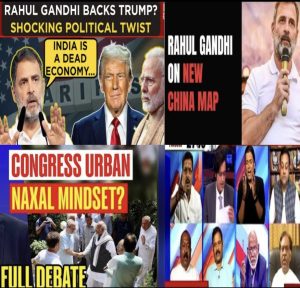
Recently, Rahul Gandhi echoed sentiments expressed by former US President Donald Trump and referred to India’s economy as a “dead economy.” Such a statement seemed not only exaggerated but could also harm India’s global image. Criticism is a democratic right, but it crosses the line when it becomes unbalanced, emotional, or overly sensational, lacking in facts.
The role of the opposition is not limited to criticism; it must also offer alternatives — in terms of policy, perspective, and leadership. A strong opposition is essential for a robust democracy. For this, opposition leaders must maintain seriousness, verify facts, and uphold ideological clarity in their statements.
At the same time, the ruling party must not forget that in a democracy, the opposition is not the enemy. Respecting and listening to the opposition is a hallmark of any strong governance system. Parliamentary debates will continue to involve accusations and counter-accusations, but if the dignity of dialogue is lost, democracy becomes nothing more than a numbers game.
Today, as India navigates a sensitive global phase — facing both internal and external challenges — both the ruling and opposition parties must deeply introspect on the tone, style, and intent of their dialogue. Many leaders in power also need to maintain decency when responding to criticism. And above all, there must be a conscious effort to curb the increasing hostility that stems from the evening debates aired on nearly every TV channel, where leaders from all parties indulge in provocation and irresponsible remarks. Such programs, often driven by the race for TRP, need serious regulation.
Leaders like Rahul Gandhi must understand that every statement they make becomes a part of national and global political discourse. Their responsibility, therefore, is not just as an opposition leader, but as a national figure — whose words, vision, and conduct could influence and inspire the youth.
In conclusion, the success of democracy lies in dialogue — mature, factual, and dignified dialogue — that includes questions and also leads to solutions. This is the true spirit of democracy.
(Rajiv Khare – Chief Editor)


 Mobile: +91 91790 14001
 Email:
  Website:
  UDYAM No.: